About 177 minutes
In Camp With A Tin Soldier — Background and Themes
Fantasy Juvenile Worlds
40,497 recorded words. 0 minutes difference from this book's estimate.
View Gutenberg source #34467
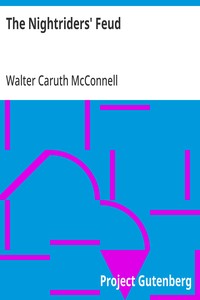
The catalog record for The Nightriders' Feud — Story, Setting & Ideas provides practical reading context through 40,546 words, 2 hr 57 min estimated reading time, and 4 detected text sections.
The text analysis averages about 17.6 words per sentence, while the detected sections provide another way to judge how the source is divided.
Project Gutenberg metadata also associates the work with “Kentucky -- Fiction,” connecting these edition facts with the source record’s subject description.
Explore this collection
These alternatives are selected using recorded categories and estimated reading time.
About 177 minutes
Fantasy Juvenile Worlds
40,497 recorded words. 0 minutes difference from this book's estimate.
View Gutenberg source #34467About 172 minutes
Fantasy Juvenile Worlds
39,524 recorded words. 5 minutes difference from this book's estimate.
View Gutenberg source #29774About 167 minutes
Fantasy Juvenile Worlds
38,349 recorded words. 10 minutes difference from this book's estimate.
View Gutenberg source #33432Search stored excerpts and compare books → Choose by your preferences →
Choices use stored catalog measurements. Estimates vary with reading speed. A shared category is a catalog label, not a claim that two books have the same argument or literary quality.
Search reads excerpt text stored with this catalog and links to its associated Gutenberg record. The connection is stored in the site database; this tool does not recheck that every excerpt is word-for-word identical to that external record. Excerpt search does not cover every chapter and does not verify historical publication dates.
Catalog snapshot checked: 2026-09-25. Coverage: 94 public books, 94 available source excerpts.
Read the complete public-domain text at its original source.
Read on Project GutenbergThe novel opens with John Redmond, freshly graduated from a New York college, planning to seek his fortune in the Western mountains—a scheme he frames as both adventure and destiny, believing the earth's wealth was placed there for his discovery. But before he can act, news arrives that his uncle has been killed by Nightriders, a vigilante group terrorizing Kentucky tobacco farmers. The murder is described with visceral specificity: a forty-four Winchester bullet, a burning home, a body shot down like a dog. Redmond's response is immediate and physical—his Southern blood boils, his teeth clench, his fists tighten—and his plans pivot from mining to vengeance.
The excerpts show a narrative voice that alternates between melodramatic interiority and stark, sensory reportage. Redmond's initial self-assurance as a brilliant engineer gives way to a world where violence is sudden, communal, and tied to economic conflict over tobacco. The story quickly shifts from one man's ambition to a broader landscape of posted warnings, burned barns, and midnight rides.
The protagonist's arc is set in motion by a single, brutal event. John Redmond, the second, has just completed his education with high honors, ready to set the world on fire with his brilliancy. But the call of the wild—a phrase the text uses—supersedes business. His plan to seek gold or coal in the Western mountains is framed as a personal destiny: the wealth was placed there by the Maker for his own pleasure, and his training will let him find what others missed. This self-assured, almost grandiose tone collapses when he learns of his uncle's murder. The shift is instantaneous: his adventurous spirit now tells him his life's work has been found in revenge.
The contrast between book learning and frontier violence is explicit. Redmond's study-ladened brain had been filled with thoughts of engineering; now it burns with Southern blood and a desire for vengeance. The narrative does not linger on his grief—instead, it emphasizes the physical reaction: teeth coming together with a sharp noise, fists clenched. The murder itself is described in clinical, almost ballistic detail (a forty-four Winchester bullet tearing his heart to pieces), yet the emotional register is overheated. This tension between precise violence and melodramatic response defines the opening.
The excerpts offer a clear picture of how the Nightriders operate. They are not random marauders but a systematic force targeting tobacco farmers who sell outside the association. Notices are posted everywhere, warning that no man shall attempt to sell tobacco openly. One such notice appears on Jack Wade's own gatepost, and he gives it deep, thoughtful consideration. The group's tactics are twofold: economic intimidation and physical destruction. They burn barns containing high-priced tobacco, devastate out-houses, and murder those who resist.
The novel's second major character, Jack Wade, is introduced as a cautious observer. He learns of a planned raid on a barn and decides to assist the officers, hoping to learn more about the Riders. His journey to the ambush site is described in detail: a long ride through the darkness, the twinkling stars providing the only light, the cuckoo singing from a distance. When the barn burns, the flame grows brighter and higher, leaping heavenward, making a terrible cracking noise. Wade watches from the brush, his heart beating heavily. The scene balances natural calm—stars, animals, dry leaves—with human terror.
The setting in the excerpts is consistently nocturnal and charged with anticipation. Night is not merely a backdrop but an active element: the Nightriders operate under cover of darkness, and the characters' movements are dictated by it. Wade's ride is described as tedious and lonesome, the darkness so deep that only the brightly shining little stars allow him to keep the road. The stars are a recurring motif—they twinkle on from their orbits, indifferent to the blood-curdling deeds below. This contrast between celestial order and human chaos is reinforced by sounds: the cuckoo singing, woodland animals scampering, dry leaves cracking—all punctuated by the sudden roar of flames.
The tension is heightened by the characters' incomplete knowledge. Wade knows the Riders' plans, but the Riders themselves are in the dark regarding the officers' identity. The narrative emphasizes the uncertainty: thoughts flit rapidly through Wade's brain, tumbling one over the other. Even the physical description of the ambush site—a quiet dark spot in the brush—suggests a world where safety is temporary. The novel's world is one where a man must be cautious on all occasions, especially when the Nightriders are active across twenty-two counties of the richest soil in Kentucky and Tennessee.
Readers should attend to the novel's handling of perspective: the excerpts shift between Redmond's interior drama and Wade's observational stance, suggesting a narrative that may juxtapose personal vengeance with communal survival. The tobacco economy is not just a backdrop but a source of conflict encoded in every posted notice and burned barn. The prose style—alternately florid and stark—invites scrutiny of how the author balances sensationalism with documentary detail. The Nightriders themselves remain partly obscured, their motives hinted at but not fully explained in these passages.
Reading about the Kentucky Nightriders’ raids, that terrible quiet before violence, I kept thinking of something in The Co-Citizens — Themes and Context—how fear settles into a town long before anyone names it aloud. Both capture that hollow ache of waiting, when ordinary people know trouble is coming and pretend otherwise. It’s a strange comfort, finding that feeling echoed elsewhere.
Save your reaction, strongest insight, and memorable passage.