About 563 minutes
The Pearl of Orr's Island: A Story of the Coast of Maine — Story, Setting & Ideas
Fantasy Juvenile Worlds
129,433 recorded words. 320 minutes difference from this book's estimate.
View Gutenberg source #31522
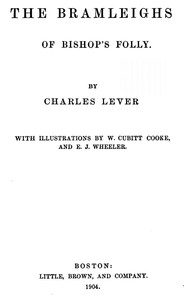
The Bramleighs of Bishop's Folly — Story, Setting & Ideas can be approached with a clearer sense of reading commitment from its source measurements: 202,985 words, 14 hr 43 min estimated reading time, and 24 detected text sections.
The text analysis averages about 18.2 words per sentence, while the detected sections provide another way to judge how the source is divided.
Project Gutenberg metadata also associates the work with “Ireland -- Fiction,” connecting these edition facts with the source record’s subject description.
Explore this collection
These alternatives are selected using recorded categories and estimated reading time.
About 563 minutes
Fantasy Juvenile Worlds
129,433 recorded words. 320 minutes difference from this book's estimate.
View Gutenberg source #31522About 361 minutes
Fantasy Juvenile Worlds
82,902 recorded words. 522 minutes difference from this book's estimate.
View Gutenberg source #34366About 317 minutes
Fantasy Juvenile Worlds
72,908 recorded words. 566 minutes difference from this book's estimate.
View Gutenberg source #33985Search stored excerpts and compare books → Choose by your preferences →
Choices use stored catalog measurements. Estimates vary with reading speed. A shared category is a catalog label, not a claim that two books have the same argument or literary quality.
Search reads excerpt text stored with this catalog and links to its associated Gutenberg record. The connection is stored in the site database; this tool does not recheck that every excerpt is word-for-word identical to that external record. Excerpt search does not cover every chapter and does not verify historical publication dates.
Catalog snapshot checked: 2026-09-25. Coverage: 94 public books, 94 available source excerpts.
Read the complete public-domain text at its original source.
Read on Project GutenbergThe Bramleighs of Bishop's Folly opens with Augustus Bramleigh receiving a lawyer's letter that casts doubt on the family's title to their estate. Lever immediately establishes a pattern of contrasting reactions: where Augustus takes a 'despairing view' and is ready to concede defeat, his lawyer Sedley urges a more pragmatic course, carefully substituting 'arrangement' for the dreaded word 'compromise.' The novel's early chapters are built around written responses—Lord Culduff's indignant refusal to contribute, Temple's sarcastic plea for increased allowance—each voice revealing a distinct brand of self-interest. Lever uses these letters not merely as plot devices but as windows into character, letting the Bramleighs condemn themselves through their own prose.
The excerpts showcase Lever's skill at differentiating characters through their written and spoken voices. Lord Culduff's reply bristles with injured dignity: he 'did not scruple to aver that it had never been his intention to embark in a ship that was sure to founder.' Temple, the younger son, responds with a blend of mockery and entitlement, questioning the need for sixteen horses and a costly chef while pleading his own poverty. Augustus himself is given to self-dramatizing speeches, lamenting that the world will 'know nothing of where my real suffering lies.' These voices do not merely convey information; they perform the speaker's social identity and moral blind spots. Lever lets each character's language expose their priorities—Culduff's concern for appearances, Temple's resentment of sibling privilege, Augustus's wounded pride—without authorial commentary.
Lever frames the legal crisis around a telling asymmetry: the claimant's case rests on documents, the Bramleighs' on 'the great fact of possession.' This contrast between paper title and long-held occupancy runs through the early chapters. Sedley admits the claimant's case 'seemed a very strong one,' while the family's only counterweight is the inertia of established ownership. Augustus's reaction—throwing down his cards at the first reverse—suggests a man who has relied on the appearance of stability rather than its substance. The novel does not resolve the legal question in the excerpts, but it dwells on the psychological effects of uncertainty: the way a single letter can transform a confident landowner into a man who 'took a despairing view of the case.' Lever is less interested in the law than in how people behave when their foundations tremble.
Money in the excerpts is never merely money; it is a measure of status, a source of grievance, a language of family obligation. Temple's letter itemizes expenses—'first peas cost you a guinea a quart,' a chef at 'two hundred and fifty a year'—as a way of accusing his brother of hypocritical extravagance. Lord Culduff frames his marriage settlement as a 'sacrifice' already made, implying that further contribution would be indecent. Even Augustus's noble lament about 'the world's judgment' is undercut by its context: he is speaking to his lawyer about a financial claim. Lever embeds economic anxiety in every exchange, from the cost of pineapples to the rent-charge on the estate. The Bramleighs' crisis is legal, but their language reveals it as a crisis of identity, where worth is calculated in pounds and appearances.
Readers should attend to the rhythm of Lever's dialogue and letters, where what is said often matters less than how it is said. The novel's tension lies not in the legal outcome but in the accumulating weight of each character's response. Notice how often characters frame their own interests as principles, and how the family's collective fate is negotiated through individual acts of self-justification. The excerpts offer no resolution, only the slow unraveling of a family's confidence in its own story.
The Bramleighs’ money squabbles lingered with me all that grey afternoon, their pride and stubbornness oddly comforting. I set the book down, and my eye caught another volume nearby, Pretty Madcap Dorothy; Or, How She Won a Lover — Inside the Classic, its title a breath of fresh air after so much inheritance gloom. A lighter quarrel, perhaps, but the same human heart.
Capture what you thought, learned, and would like to remember.