About 297 minutes
Happy House — Inside the Classic
Fantasy Juvenile Worlds
68,185 recorded words. 16 minutes difference from this book's estimate.
View Gutenberg source #32053
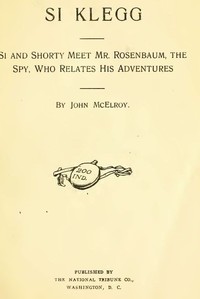
Si Klegg, Book 3 Si and Shorty Meet Mr. Rosenbaum, the Spy, Who Relates His Adventures — Key Ideas to Explore can be approached with a clearer sense of reading commitment from its source measurements: 64,521 words, 4 hr 41 min estimated reading time, and 9 detected text sections.
The text analysis averages about 14.7 words per sentence, while the detected sections provide another way to judge how the source is divided.
Project Gutenberg metadata also associates the work with “United States -- History -- Civil War, 1861-1865 -- Fiction,” connecting these edition facts with the source record’s subject description.
Explore this collection
These alternatives are selected using recorded categories and estimated reading time.
About 297 minutes
Fantasy Juvenile Worlds
68,185 recorded words. 16 minutes difference from this book's estimate.
View Gutenberg source #32053About 264 minutes
Fantasy Juvenile Worlds
60,531 recorded words. 17 minutes difference from this book's estimate.
View Gutenberg source #32928About 307 minutes
Fantasy Juvenile Worlds
70,505 recorded words. 26 minutes difference from this book's estimate.
View Gutenberg source #29776Search stored excerpts and compare books → Choose by your preferences →
Choices use stored catalog measurements. Estimates vary with reading speed. A shared category is a catalog label, not a claim that two books have the same argument or literary quality.
Search reads excerpt text stored with this catalog and links to its associated Gutenberg record. The connection is stored in the site database; this tool does not recheck that every excerpt is word-for-word identical to that external record. Excerpt search does not cover every chapter and does not verify historical publication dates.
Catalog snapshot checked: 2026-09-25. Coverage: 94 public books, 94 available source excerpts.
Read the complete public-domain text at its original source.
Read on Project GutenbergThe third Si Klegg book opens with a marked shift in narrative rhythm. Where earlier installments moved briskly through camp life and skirmishes, this volume slows to accommodate the extended, first-person account of Mr. Rosenbaum, the spy. His speech—peppered with phrases like “I know you, unt what you're here for”—introduces a Germanic cadence that stands apart from the colloquial Indiana dialect of Si and Shorty. The change in pace is not merely a matter of plot; it signals a deliberate expansion of narrative voice, as the author allows a secondary character to dominate the storytelling for several chapters.
Rosenbaum's speech patterns are the most immediately noticeable feature of this book. His lines, such as “I know you, unt what you're here for,” employ a thickened German accent that no other character shares. This is not a casual choice: the dialect slows the reader's pace, forcing attention on each word. The spy's voice also carries a theatrical quality—he relates his adventures with a showman's flair, as when he describes nearly being caught by Sigel's pickets. By contrast, Si and Shorty speak in a more clipped, rural Indiana vernacular (“I kin duck any man in the 200th Injianny”). The juxtaposition creates a layered soundscape, where the spy's foreignness is both a plot point and a stylistic counterweight to the protagonists' familiar tones.
Shorty, previously defined by his indifference to mail and his rough-and-tumble past “cuttin' wood down the Mississippi,” undergoes a sudden inward turn. The arrival of a letter from Bad Ax, Wisconsin, triggers a sequence of quiet, almost obsessive behaviors: he steals off into the brush to reread the letter, he frets over the security of the mails, and he falls into “fits of silent musing.” Si notices the change and worries that a rebel bullet has affected Shorty's mind. This episode marks a sharp deceleration from the earlier picket-line banter and wrestling challenges. The narrative pace here becomes introspective, dwelling on a single character's emotional state rather than external action. The contrast is striking: a book that begins with a spy's breathless tale soon lingers on a man reading a letter in the woods.
McElroy varies the book's tempo by alternating between rapid-fire dialogue and deliberate silence. The picket-line scene, for instance, moves quickly: challenges are shouted, a wrestling match is proposed, and a false alarm sends both sides scrambling. The sentences are short, the action immediate. Later, when Shorty receives his letter, the prose becomes meditative, with longer paragraphs describing his thoughts and habits. The author also uses the mail distribution as a structural pause—a moment when the entire regiment halts its routine. This rhythm is not accidental; it mirrors the soldiers' own experience of war, where bursts of danger are followed by long stretches of waiting. The reader, like the men in camp, must adjust to sudden shifts in tempo, from the spy's rapid-fire narration to the stillness of a man holding a letter.
Readers approaching this third volume should attend to its changes in tempo as closely as its changes in setting. The book does not simply continue the adventures of Si and Shorty; it experiments with who gets to tell the story and how fast that story unfolds. Pay attention to the moments when the prose slows—those are where McElroy is doing his most careful character work.
There’s a moment in Si Klegg where the spy’s yarns give way to Shorty’s quiet letter, and I thought of another soldier’s tale, tender as worn paper — In Camp With A Tin Soldier — Background and Themes. Both hold that same hushed pause between bravado and longing, like old friends pausing by a fire.
Use these questions to collect your thoughts before moving on.