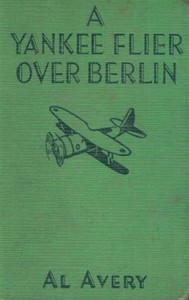
The novel opens not with a dogfight but with a colonel staring at a map, his finger on a Luftwaffe field under 6/10 cloud cover. The tension between fighter cover and bomber self-sufficiency is established immediately: Weather Officer Miller grins cockily that the Forts and Libs will make it alone, while Colonel Holt argues for longer-range escorts. This strategic debate grounds the story in a specific historical moment—1944, when Allied fighters lacked the range to reach Berlin. The setting is drab and raw: a wind stabs, clouds scud, and a night fighter growls overhead. The base is half-finished, with mud ruts and shadowy Thunderbolts. The prose favors concrete military detail over heroics, focusing on the mechanics of war.
Escape Through Garbage
The escape sequence in Chapter VIII relies on sensory immersion rather than gunplay. Sim leads Stan and O'Malley to a garbage truck; the smell is described as “very strong” and “sweet smellin’” by O'Malley. The boys hide among cans, which clang and bang as the truck lurches. Darkness is total. The plan hinges on exploiting German distaste for examining garbage: “The smell will keep the Germans from examining it very closely,” Sim says, chuckling. The detail that prisoners in the ghetto are allowed to pick over garbage turns the escape into a moral revelation—Stan feels his stomach turn. The escape is messy, noisy, and undignified, a far cry from aerial heroics.
Voice and Dialogue
The dialogue is terse and functional, with occasional humor. O'Malley provides comic relief: “'Tis a sweet smellin' cab ye called,” he says of the garbage truck. When told they must hide in the cans, he protests, “They're full o' garbage.” Sim's replies are sharp and practical: “We'll empty three cans.” The characters rarely express emotion directly; instead, actions speak. Stan “grinned in the darkness” upon recognizing the garbage lorry. The prose avoids interior monologue, relying on physical reactions—Stan's stomach turning, O'Malley being “stumped for words.” This restraint gives the escape a documentary feel, as if the reader is crouched beside them.
Structure and Pacing
The narrative alternates between broad strategic scenes and tight, claustrophobic action. Chapter I spends paragraphs on weather reports and command debates before a single shot is fired. The escape, by contrast, is a continuous sequence of small, precise movements: climbing a rope, moving cans, crouching in the truck. Time is compressed; the escape happens in minutes, but the description lingers on each step. The author uses sensory markers—the snap of a light, the shout in German, the sputtering truck—to build tension. The result is a story that values procedure over spectacle, showing how war is fought in brief, intense bursts of improvisation.
Readers should pay attention to how the novel balances its two scales: the grand strategy of bomber command and the grimy, small-scale reality of evasion. The excerpts suggest that survival depends on exploiting the enemy's assumptions—about garbage, about darkness, about what prisoners will do. The prose is lean, favoring action over introspection. This is a book that trusts its readers to infer character from gesture and dialogue, not from internal monologue.
That rainy afternoon, I kept thinking about how A Yankee Flier Over Berlin smelled—oil, sweat, crushed grass—more than the dogfights themselves. The escape felt less heroic than grimy, almost accidental. Oddly, that same groundedness surfaced in The Nightriders' Feud — Story, Setting & Ideas, where a feud settles into field mud and fence wire. I closed both books wondering if all adventures are, at heart, just weather and stubborn footsteps.