About 172 minutes
A Yankee Flier Over Berlin — Text and Context
Fantasy Juvenile Worlds
39,524 recorded words. 5 minutes difference from this book's estimate.
View Gutenberg source #29774
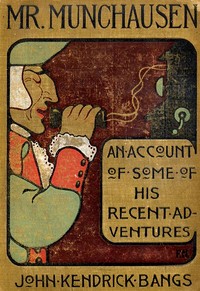
The source record for Mr. Munchausen Being a True Account of Some of the Recent Adventures beyond the Styx of the Late Hieronymus Carl Friedrich, Sometime Baron Munchausen of Bodenwerder — Story, Setting & Ideas measures this digital text at 38,349 words, 2 hr 47 min estimated reading time, and 16 detected text sections.
The text analysis averages about 19.3 words per sentence, while the detected sections provide another way to judge how the source is divided.
Project Gutenberg metadata also associates the work with “Humorous stories, American,” connecting these edition facts with the source record’s subject description.
Explore this collection
These alternatives are selected using recorded categories and estimated reading time.
About 172 minutes
Fantasy Juvenile Worlds
39,524 recorded words. 5 minutes difference from this book's estimate.
View Gutenberg source #29774About 177 minutes
Fantasy Juvenile Worlds
40,546 recorded words. 10 minutes difference from this book's estimate.
View Gutenberg source #33829About 177 minutes
Fantasy Juvenile Worlds
40,497 recorded words. 10 minutes difference from this book's estimate.
View Gutenberg source #34467Search stored excerpts and compare books → Choose by your preferences →
Choices use stored catalog measurements. Estimates vary with reading speed. A shared category is a catalog label, not a claim that two books have the same argument or literary quality.
Search reads excerpt text stored with this catalog and links to its associated Gutenberg record. The connection is stored in the site database; this tool does not recheck that every excerpt is word-for-word identical to that external record. Excerpt search does not cover every chapter and does not verify historical publication dates.
Catalog snapshot checked: 2026-09-25. Coverage: 94 public books, 94 available source excerpts.
Read the complete public-domain text at its original source.
Read on Project GutenbergJohn Kendrick Bangs's Mr. Munchausen (1901) picks up the legendary baron after his death, placing him in the underworld as a celebrity interviewed by none other than Ananias—the biblical figure synonymous with lying—for the Gehenna Gazette. The premise alone signals a self-aware satire: the baron's tall tales are now reported by a professional prevaricator. Bangs's editor's apology insists Munchausen has been misunderstood as a liar, comparing him favorably to a fictional realist author named Mr. Corridor Walkingstick. This mock-scholarly framing sets up a work that constantly questions truth and fiction.
The narrative structure is a layered joke. The book claims to be a transcription from the Gehenna Gazette, a newspaper in Hades, by Ananias, its special interviewer. Ananias himself is a liar of biblical proportions, making him the perfect chronicler for Munchausen's exaggerations. In the excerpts, Ananias and his wife Sapphira visit the baron, who tells them a story about escaping a lion by climbing a giraffe. When Sapphira scoffs, Ananias offers a skeptical quip about a coconut, but the baron calmly tops himself by comparing the giraffe's height to the Eiffel Tower. The baron then dismisses his guests as "deadly amateurs" at lying. This meta-humor—liars judging each other—is central to the book's tone.
Bangs uses Munchausen to parody late-19th-century literary movements. The editor's apology mocks "Manx Realism" through the invented author Mr. Corridor Walkingstick and his novel about a clergyman named John Stress and a heroine called Glory Partridge. The apology claims Munchausen's veracity equals Walkingstick's, a satirical jab at the pretensions of realism. In the Decoration Day excerpt, Munchausen declines to tell a straightforward patriotic story, instead offering a cannibal-island version. He notes that a poet could express the beauty of honoring fallen soldiers, but he himself would have to dwell on unknown graves—a subtle critique of sentimental nationalism. The book thus balances absurdity with pointed commentary.
Munchausen's voice remains consistently calm and self-satisfied, even when his tales become preposterous. In the lion-giraffe story, he describes his escape with matter-of-fact detail: "I reached the giraffe, caught his tail, raised myself up to his back, crawled along his neck and dropped fainting into the tree." The deadpan delivery contrasts with the escalating absurdity. The baron also uses precise, pseudo-logical reasoning—deducing the lion's broken neck from the giraffe's hypothetical movement. This blend of hyperbole and mock-seriousness defines the book's humor. Structurally, the frame allows for multiple embedded tales, each introduced by a listener's request, as when Diavolo asks for a Decoration Day story. The result is a flexible, episodic format that keeps the focus on the baron's improvisational wit.
Readers should approach Mr. Munchausen as a knowing parody rather than a straightforward adventure collection. The frame narrative and editorial asides reward attention to Bangs's satirical targets, which include literary realism, journalism, and patriotic sentiment. The baron's unflappable narration invites readers to enjoy the absurdity while recognizing the layered jokes about truth-telling. Peter Newell's illustrations, mentioned in the front matter, add a visual dimension to the humor.
Years among the stacks taught me how Mr. Munchausen whispers its own elegant mischief—that fiction needn’t apologize for lying. It made me think of Death Makes a Mistake — Edition Insights, another little volume where the impossible merely tips its hat. They share a gentle wink, these two—companions in the quiet art of not quite believing, yet smiling anyway.
Build a private reading journal entry for this title.