About 151 minutes
Orphans of the Storm — Reading Companion
Adventure Picaresque Fiction
34,568 recorded words. 20 minutes difference from this book's estimate.
View Gutenberg source #30300
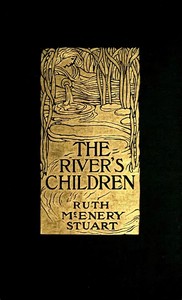
For The River's Children: An Idyl of the Mississippi — Reading Notes, the stored edition analysis reports 30,106 words, 2 hr 11 min estimated reading time, and 4 detected text sections.
The text analysis averages about 20.3 words per sentence, while the detected sections provide another way to judge how the source is divided.
Project Gutenberg metadata also associates the work with “Conduct of life -- Fiction,” connecting these edition facts with the source record’s subject description.
Explore this collection
These alternatives are selected using recorded categories and estimated reading time.
About 151 minutes
Adventure Picaresque Fiction
34,568 recorded words. 20 minutes difference from this book's estimate.
View Gutenberg source #30300About 188 minutes
Adventure Picaresque Fiction
43,038 recorded words. 57 minutes difference from this book's estimate.
View Gutenberg source #31836About 71 minutes
Adventure Picaresque Fiction
16,191 recorded words. 60 minutes difference from this book's estimate.
View Gutenberg source #32847Search stored excerpts and compare books → Choose by your preferences →
Choices use stored catalog measurements. Estimates vary with reading speed. A shared category is a catalog label, not a claim that two books have the same argument or literary quality.
Search reads excerpt text stored with this catalog and links to its associated Gutenberg record. The connection is stored in the site database; this tool does not recheck that every excerpt is word-for-word identical to that external record. Excerpt search does not cover every chapter and does not verify historical publication dates.
Catalog snapshot checked: 2026-09-25. Coverage: 94 public books, 94 available source excerpts.
Read the complete public-domain text at its original source.
Read on Project GutenbergThe Mississippi River opens this novel as an active, threatening presence, flaunting itself against levees and swallowing plantations. The first chapter describes gangs of Black laborers reinforcing danger points with pickax and spade, sustained by a pink concoction that spurs song and jest. The river is not mere backdrop but a force that shapes the narrative, from the opening crisis to the ferry crossing that brings Harold Le Duc home.
Ruth McEnery Stuart, known for her dialect writing, centers the story on the reunion of Harold with Israel and Hannah, the couple who raised him. Their speech is rendered in a thick vernacular, and the plot hinges on a horn—carried by Israel across the flood—whose call Harold recognizes. The catalog subjects list “Conduct of life” and “African Americans,” but the excerpts show a more specific focus: the dynamics of loyalty, memory, and class across racial lines in a post-Reconstruction setting.
The Mississippi is described as “flaunting itself in the face of opposition,” and the opening pages detail its destruction: plantations taken, settlements submerged. The response is a human chain of laborers, “negroes mostly,” working day and night. The text emphasizes the sound of the river—laughter, rhythmic voices, a work song: “Sing, nigger, sing! / Sing yo' hymn! / De river, she's a-boomin'—she's a-comin che-bim!” This song, with its call to “Swim, nigger, swim!” and “Climb, squirrel, climb!” blends urgency with a folk cadence that Stuart sustains throughout.
The flood also serves as a plot mechanism: it forces Harold to cross the river, where he encounters Israel’s ferry. The horn that Israel blows across the water becomes the means of recognition. The river thus is both a literal threat and a symbolic boundary that the characters must navigate to reconnect.
Stuart renders the speech of Israel and Hannah in a dense dialect that carries emotional weight. When Harold returns, Hannah presses him “to better study his face at long range” and asks, “What happened to yo' hair, Baby?” She notes it is “as bright as dat flaxion curl o' yoze I got in my Testamen'.” This detail—a curl kept in a Bible—anchors their bond in a tangible keepsake from the past.
Israel’s account of the ferry ride is a set piece of comic and poignant storytelling. He describes how he “all but shuk de ole skift to pieces” when Harold stepped aboard, and how he “s'luted him for a gentleman, an' axed him for Gord sake to set down.” The humor masks the gravity of recognition: when Harold asks “whar's Mammy Hannah?” Israel “des nachelly clawed him an' drug him.” The dialect is not merely decorative; it conveys character, history, and the texture of a relationship shaped by slavery and its aftermath.
The horn is the central object in the excerpts. Israel brings it “f'om de islan' roun' my neck, clean 'crost de flood,” and Hannah had “made game o' me” for keeping it. Yet it proves essential: “cep'n' for de horn's call bein' so familius, he'd 'a' paid me my dime like a stranger an' passed on.” The horn functions as a token of identity and continuity, linking Harold to his childhood home.
The catalog subject “Poverty” appears only indirectly: Israel says “dey don't charge nothin' in dese han'-to-mouf days,” and the ferry is a makeshift skift. But the excerpts do not reveal the full arc of the plot—whether Harold stays, how the flood resolves, or what becomes of the characters. The novel’s subtitle calls it an “Idyl,” suggesting a pastoral or idealized treatment, but the opening flood and the characters’ histories hint at tensions the excerpts leave unexplored.
Readers should attend to how Stuart balances the river’s destructive power with the intimate reunion of Harold, Israel, and Hannah. The dialect requires careful reading but rewards attention to its rhythms and emotional nuances. The horn, the curl, and the flood are not just plot devices but symbols of memory and survival. Because the excerpts cover only the opening and a middle scene, the novel’s full trajectory—especially its treatment of poverty and conduct—remains to be discovered in the complete text.
That flood story stayed with me for how quietly it holds the weight of a family pieced back together through memory and sound—one horn, one call across water. It reminded me, oddly, of The Swiss Family Robinson; or, Adventures on a Desert Island — Themes and Context, where survival feels less like adventure and more like the slow work of belonging again. Both left me thinking about what home means when the ground shifts.
Answer a few questions and save a private reflection on this device.