About 49 minutes
The Supply at Saint Agatha's — A Reader’s Guide
Adventure Picaresque Fiction
11,188 recorded words. 22 minutes difference from this book's estimate.
View Gutenberg source #34256
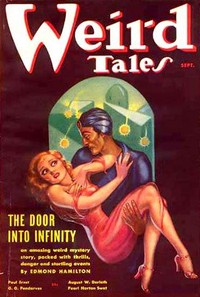
This digital edition of The Door into Infinity — A Closer Reading is described by source-level measurements including 16,191 words, 1 hr 11 min estimated reading time, and 2 detected text sections.
The text analysis averages about 15.2 words per sentence, while the detected sections provide another way to judge how the source is divided.
Project Gutenberg metadata also associates the work with “Adventure stories,” connecting these edition facts with the source record’s subject description.
Explore this collection
These alternatives are selected using recorded categories and estimated reading time.
About 49 minutes
Adventure Picaresque Fiction
11,188 recorded words. 22 minutes difference from this book's estimate.
View Gutenberg source #34256About 131 minutes
Adventure Picaresque Fiction
30,106 recorded words. 60 minutes difference from this book's estimate.
View Gutenberg source #34416About 151 minutes
Adventure Picaresque Fiction
34,568 recorded words. 80 minutes difference from this book's estimate.
View Gutenberg source #30300Search stored excerpts and compare books → Choose by your preferences →
Choices use stored catalog measurements. Estimates vary with reading speed. A shared category is a catalog label, not a claim that two books have the same argument or literary quality.
Search reads excerpt text stored with this catalog and links to its associated Gutenberg record. The connection is stored in the site database; this tool does not recheck that every excerpt is word-for-word identical to that external record. Excerpt search does not cover every chapter and does not verify historical publication dates.
Catalog snapshot checked: 2026-09-25. Coverage: 94 public books, 94 available source excerpts.
Read the complete public-domain text at its original source.
Read on Project GutenbergEdmond Hamilton opens The Door into Infinity with a ritualistic catechism—"Where leads the Door?" / "It leads outside our world"—that immediately establishes the cult's otherworldly stakes. The dialogue is clipped and repetitive, mimicking incantation, while the setting is sketched in swift, sensory strokes: a "gloomy little office," "thickening, foggy twilight." Paul Ennis, the American protagonist, is introduced through agitated physicality—he "kicked back his chair," "gripping its edges with his hands"—rather than interior monologue. Inspector Campbell, by contrast, speaks in a "flat voice," his eyes "like two crumbs of bright brown glass." This contrast in diction and demeanor drives the early tension.
The Brotherhood of the Door communicates through a fixed verbal formula. When Campbell and Ennis infiltrate the cult, they must answer a challenge: "Are you who come here of the Brotherhood of the Door?" The response is prescribed: "We are of the Brotherhood." This coded language functions as a password, but it also signals the cult's hierarchical, ritualistic nature. Hamilton underscores the danger of linguistic missteps: when the hooded guard asks why they lack the badge, Campbell must produce the emblem to avoid exposure. The dialogue is stripped of ornament—no contractions, no hesitation—creating a sense of mechanical obedience. Even the guard's shift to "slightly more natural tones" after the exchange hints at the strain of maintaining the facade.
Hamilton conveys Ennis's desperation through repeated, specific physical details rather than psychological exposition. His "haggard face uncomprehending in expression," his "crisp yellow hair brushed back from his forehead in disorder," and his "blue eyes haunted with an anguished dread" all appear within the first pages. Later, when Ennis confronts Chandra Dass, his voice "cracked" as he cries, "You damned fiend, where's my wife?" The shift from controlled anguish to shrill outburst is marked by a change in sentence rhythm—from measured clauses to fragmented exclamations. Campbell, by contrast, remains physically still: "unmoved," his face "colorless, sagging." This asymmetry in physical responsiveness heightens the power imbalance between the frantic amateur and the stoic investigator.
The setting is established in the opening paragraph: "the thickening, foggy twilight of London." Fog recurs not as mere atmosphere but as a narrative constraint—it limits visibility, isolates characters, and creates a claustrophobic pressure that mirrors Ennis's psychological state. When the action moves underground to the water-cavern, the fog is replaced by "sourceless" light and rock-hewn tunnels, but the sense of enclosure persists. Hamilton uses the fog to justify the characters' limited perception: Ennis sees his wife "whisked into a limousine" but cannot pursue; the police are slow to act. The fog thus becomes a passive antagonist, enabling the cult's secrecy and the protagonist's helplessness.
Chandra Dass speaks in a "strong, vibrant voice" that carries "a scorn that was almost pitying." His dialogue is formal and sardonic: "It occurred to me that your enterprise might enable you to escape the daggers of my followers." The contrast between his polished diction and the cult's ritualistic chants underscores the dual nature of the threat—both organized and fanatical. The hooded figures, by contrast, are nearly voiceless; they act in unison, "with loud cries," and their speech is limited to formulaic exchanges. Hamilton thus uses voice to differentiate levels of agency: the leader commands language, while the followers are reduced to collective exclamations. This hierarchy is reinforced by the emblem—a "double star" for Chandra Dass versus a single star for others—but it is in dialogue that the power structure is most sharply drawn.
Readers attentive to Hamilton's craft will notice how he builds suspense through restraint: the fog is never overdescribed, the cult's rituals are never fully explained, and Ennis's emotions are shown through action rather than introspection. The novella rewards close attention to its verbal patterns—the repeated questions, the flat rejoinders, the sudden shifts in register. What remains unsaid often carries as much weight as what is spoken.
There’s something about Hamilton’s fog-bound doors that lingers, that sense of a threshold almost crossed. It reminds me of the quiet ache in The Lady of Loyalty House: A Novel — the way loyalty itself becomes a kind of doorway, closing softly behind you. I still think about that one sometimes, on grey afternoons. The Lady of Loyalty House: A Novel — Key Ideas to Explore captures that feeling, gently, without hurrying.
Save your reaction, strongest insight, and memorable passage.