About 124 minutes
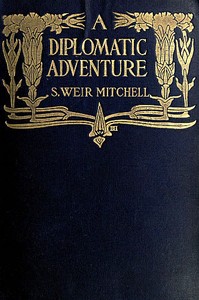
A Diplomatic Adventure — Reading Companion
Historical Psychological Social Fiction
28,317 recorded words. 3 minutes difference from this book's estimate.
View Gutenberg source #30585
Before opening The Smart Set: Correspondence & Conversations — Reading Notes, the edition data offers a quick orientation: 29,130 words, 2 hr 7 min estimated reading time, and 4 detected text sections.
The text analysis averages about 15.2 words per sentence, while the detected sections provide another way to judge how the source is divided.
Project Gutenberg metadata also associates the work with “Imaginary letters,” connecting these edition facts with the source record’s subject description.
Explore this collection
These alternatives are selected using recorded categories and estimated reading time.
About 124 minutes
Historical Psychological Social Fiction
28,317 recorded words. 3 minutes difference from this book's estimate.
View Gutenberg source #30585About 184 minutes
Historical Psychological Social Fiction
42,289 recorded words. 57 minutes difference from this book's estimate.
View Gutenberg source #31320About 188 minutes
Historical Psychological Social Fiction
43,082 recorded words. 61 minutes difference from this book's estimate.
View Gutenberg source #33399Search stored excerpts and compare books → Choose by your preferences →
Choices use stored catalog measurements. Estimates vary with reading speed. A shared category is a catalog label, not a claim that two books have the same argument or literary quality.
Search reads excerpt text stored with this catalog and links to its associated Gutenberg record. The connection is stored in the site database; this tool does not recheck that every excerpt is word-for-word identical to that external record. Excerpt search does not cover every chapter and does not verify historical publication dates.
Catalog snapshot checked: 2026-09-25. Coverage: 94 public books, 94 available source excerpts.
Read the complete public-domain text at its original source.
Read on Project GutenbergClyde Fitch's The Smart Set: Correspondence & Conversations (1897) opens with a husband's letter to his brother in Denver, complaining that his wife's ball left him with no room of his own and the obligation to help receive guests. The voice is weary, sardonic, and intimate—but the same event, refracted through other letters, reveals entirely different attitudes. This structure of multiple perspectives, each partial and self-serving, is the book's central device.
The excerpts show a world where a letter of introduction can be immediately contradicted by a second letter asking the recipient to ignore it. Social performance is paramount, and sincerity is a liability. Fitch, a playwright known for drawing-room comedies, applies a theatrical sensibility to epistolary fiction: every character is both actor and audience.
The most striking pattern in the excerpts is the use of paired letters that cancel each other out. In “A Letter of Introduction,” Mrs. Joslyn first writes a warm note introducing Mr. Hamilton-Locks to Mrs. Lemaire, then immediately sends a second letter confessing the introduction is a sham: “pay no attention whatever to it.” The young Englishman is a “bother,” forced on her by a traveling acquaintance. Yet Mrs. Lemaire’s reply reveals he has become a social success, “constantly at the P——’s,” with women “mad about him.”
This sequence exposes a layered dishonesty: the initial letter is a required form, the second is a private correction, and the third shows the correction is useless. The reader sees the gap between what is said and what is meant, and between what is meant and what happens. Fitch uses the epistolary form to dramatize how social currency—a letter of introduction—can be simultaneously issued and devalued by its own author.
In the opening letter, Wm. H. Makeway mentions almost in passing that he and his wife Julia “haven’t shared the same room for years, not since the six months she spent with her married sister, Lady Glenwill.” The detail is dropped casually, but it signals a marriage of separate spheres: his bedroom is given over to male guests, his study becomes a smoker, and he is left “to hang around in any place I could find.”
This spatial arrangement recurs as a motif. The husband is displaced in his own home; the wife orchestrates the social event that causes the displacement. Fitch does not moralize, but the physical separation of husband and wife—and the husband’s resentment at being a guest in his own house—suggests a transaction: he pays the bills, she runs the show. The letter’s tone, half-admiring (“She is a wonder!”) and half-bitter, captures the ambivalence of a man who both respects and resents his wife’s social competence.
Mr. Hamilton-Locks, the English visitor, writes to a friend in England comparing Washington and New York. He finds Washington “more like European without trying to be, while in New York they try more, and aren’t.” This observation, embedded in a private letter, crystallizes a tension running through the excerpts: the anxiety of imitation. New York society, in Fitch’s depiction, is self-consciously performative—it tries to be European and fails; Washington, by contrast, achieves a natural cosmopolitanism.
The same letter mentions Mrs. Joslyn’s introduction as a near-mistake (“I was so afraid I’d forget and use it by mistake”) and dismisses her as a social liability. The visitor’s perspective provides an external gauge: he sees the hierarchies and pretensions that the New York characters take for granted. Fitch uses the outsider’s voice to highlight the provincialism beneath the smart set’s sophistication.
Readers should attend to what is not said in these letters—the omissions, the afterthoughts, the letters that contradict earlier ones. Fitch’s characters are never fully reliable, and the gaps between their public and private selves are where the real story lies. The book rewards attention to small details: a dropped title, a changed salutation, a postscript that undoes the body of the letter. Treat each correspondence as a performance, and the collection as a backstage pass.
Fitch’s letters are the performance—the way we edit ourselves for someone, then whisper the truth to the mirror. That gap between what’s sent and what’s felt stayed with me for days. I found a similar quiet ache in Rose O'Paradise — Context and Discussion, the way a person’s private longing never quite fits the life they’re handed. It lingers like a room you’ve just left.
A brief reflection can help important ideas stay with you longer.