About 189 minutes
Mrs. Tree — Context and Discussion
Historical Psychological Social Fiction
43,326 recorded words. 1 minutes difference from this book's estimate.
View Gutenberg source #30439
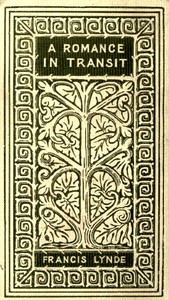
Before opening A Romance in Transit — A Reader’s Guide, the edition data offers a quick orientation: 43,082 words, 3 hr 8 min estimated reading time, and 5 detected text sections.
The text analysis averages about 15.5 words per sentence, while the detected sections provide another way to judge how the source is divided.
Project Gutenberg metadata also associates the work with “Fiction,” connecting these edition facts with the source record’s subject description.
Explore this collection
These alternatives are selected using recorded categories and estimated reading time.
About 189 minutes
Historical Psychological Social Fiction
43,326 recorded words. 1 minutes difference from this book's estimate.
View Gutenberg source #30439About 184 minutes
Historical Psychological Social Fiction
42,289 recorded words. 4 minutes difference from this book's estimate.
View Gutenberg source #31320About 209 minutes
Historical Psychological Social Fiction
47,880 recorded words. 21 minutes difference from this book's estimate.
View Gutenberg source #28492Search stored excerpts and compare books → Choose by your preferences →
Choices use stored catalog measurements. Estimates vary with reading speed. A shared category is a catalog label, not a claim that two books have the same argument or literary quality.
Search reads excerpt text stored with this catalog and links to its associated Gutenberg record. The connection is stored in the site database; this tool does not recheck that every excerpt is word-for-word identical to that external record. Excerpt search does not cover every chapter and does not verify historical publication dates.
Catalog snapshot checked: 2026-09-25. Coverage: 94 public books, 94 available source excerpts.
Read the complete public-domain text at its original source.
Read on Project GutenbergFrom its first sentence, A Romance in Transit announces itself as a story of movement: Train Number Three, the “Flying Kestrel,” crosses the “yellow Rubicon of the West” and climbs the Great Plain. The opening chapter, “P. P. C. Ariadne,” introduces the Pullman car as a microcosm, cataloging passengers with the brisk specificity of a train manifest—a sun-browned ranchman, a pair of school-teachers, a Mormon elder, a Denver banker, and the inevitable newlyweds. Lynde’s narrative voice shifts between panoramic overview and close-up detail, a technique that mirrors the train’s own rhythm of long views and sudden stops.
The sleeping-car “Ariadne” is more than a setting; it is a narrative device that concentrates characters and controls pace. Lynde opens with a slow, observant sweep: the morning is perfect, the train on time, and each passenger “settled himself, according to his gifts, to enjoy or endure the day-long run.” This measured cataloging gives way to tighter focus on Burton and his wife, who wait for eggs and coffee after a missed breakfast. The car’s narrow table between them becomes a frame for intimate exchange. Later, in Chapter XVI, the platform of the Denver Union Depot explodes into a “moving spectacle” of trains, trucks, and shouting yard-men. The prose accelerates: “shrieking safety-valves, the clanging bells, the tinnient gong of the breakfast-room, the rumbling trucks, and the under-roar of matter in motion.” Lynde uses these contrasting spaces—the confined car and the chaotic depot—to modulate tension, shifting from interior quiet to public noise.
Lynde’s dialogue often accelerates the narrative, especially in crowd scenes. In the depot, Brockway, the passenger agent, fields a rapid-fire chorus of questions from the “Personally Conducted” tourists: “How long did you say we’d have?” “What are they going to do with our car while we’re gone?” “Say, Mr. Passenger Agent, are you sure the baggage will be safe?” The exchange is rendered as a script-like list, with each query punctuated by Brockway’s terse replies. This staccato rhythm contrasts with the more measured, descriptive passages of the opening. The gadfly character, who “quavers” and insists on not losing sight of Brockway, adds a comic persistence that breaks the flow. Lynde also uses sotto voce asides—Mr. Somers muttering “Hang Dicky! Let’s go to breakfast”—to inject humor and speed. The dialogue does not merely convey information; it shapes the reading tempo, mimicking the hurry of travel.
Lynde’s narrator shifts between detached observation and a knowing, almost editorial tone. The opening describes passengers with the eye of a social cataloguer: the ranchman “homeward bound from the Chicago stockyards,” the Mormon elder “smug in ready-made black,” the Catholic priest “two hundred pounds of good-natured, comfort-loving” presence. Later, in the depot scene, the narrator steps back to remark on historical change: “It is all very different now, I am told. They have iron railings with wicket-gates and sentinels in uniform… and all the other appurtenances and belongings of a well-conducted railway terminus.” This interjection—a rare first-person plural—“I am told”—creates a temporal distance, contrasting the “elder order of disorder” with modern order. The voice is not uniformly omniscient; it sometimes aligns with a character’s perspective, as when Harry Quatremain stands “aloof” and observes Brockway’s maneuvering. This flexibility in narrative stance keeps the reader attuned to both the broad social canvas and the private drama unfolding within it.
Readers attentive to narrative craft will find in A Romance in Transit a deliberate interplay of speed and stillness. Lynde’s prose accelerates in dialogue and crowd scenes, then slows for interior moments or descriptive set-pieces. The train itself becomes a metaphor for this pacing: it rushes across the plain, stops at stations, and idles on sidings. Watching how the author shifts gears—from the Pullman’s quiet intimacy to the depot’s cacophony—offers a way into the novel’s structure. The romance, like the journey, unfolds in transit.
That rainy afternoon, A Romance in Transit kept me company while thunder rolled over the depot. I found myself thinking about quiet persistence—how two strangers circled each other in that Pullman car, words clipped but hearts unhurried. Later, almost by accident, I picked up Cinderella Jane — Reading Companion, and the same tender patience seemed to linger there, like lamplight through a curtain.
Your answers remain private and are stored only in this browser.