About 117 minutes
The Beautiful Miss Brooke — Context and Discussion
Machines Inventions Early Science Fiction
26,713 recorded words. 16 minutes difference from this book's estimate.
View Gutenberg source #34404
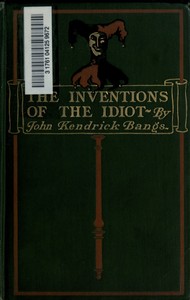
This digital edition of The Inventions of the Idiot — Inside the Classic is described by source-level measurements including 30,362 words, 2 hr 13 min estimated reading time, and 3 detected text sections.
The text analysis averages about 17.1 words per sentence, while the detected sections provide another way to judge how the source is divided.
Project Gutenberg metadata also associates the work with “Humorous stories,” connecting these edition facts with the source record’s subject description.
Explore this collection
These alternatives are selected using recorded categories and estimated reading time.
About 117 minutes
Machines Inventions Early Science Fiction
26,713 recorded words. 16 minutes difference from this book's estimate.
View Gutenberg source #34404About 180 minutes
Machines Inventions Early Science Fiction
41,360 recorded words. 47 minutes difference from this book's estimate.
View Gutenberg source #32581About 187 minutes
Machines Inventions Early Science Fiction
42,811 recorded words. 54 minutes difference from this book's estimate.
View Gutenberg source #28595Search stored excerpts and compare books → Choose by your preferences →
Choices use stored catalog measurements. Estimates vary with reading speed. A shared category is a catalog label, not a claim that two books have the same argument or literary quality.
Search reads excerpt text stored with this catalog and links to its associated Gutenberg record. The connection is stored in the site database; this tool does not recheck that every excerpt is word-for-word identical to that external record. Excerpt search does not cover every chapter and does not verify historical publication dates.
Catalog snapshot checked: 2026-09-25. Coverage: 94 public books, 94 available source excerpts.
Read the complete public-domain text at its original source.
Read on Project GutenbergThe Idiot first appears as a plain boarder, not yet married, lodging at Mrs. Smithers-Pedagog's High-class Home for Single Gentlemen. His opening complaint about a burned steak—comparing a cook's error to cannibal justice—establishes the book's method: trivial domestic grievances are inflated into platforms for elaborate, impractical inventions. The dialogue moves swiftly, with the Idiot's deadpan logic colliding against the School-master's pedantry, the Poet's romanticism, and the Bibliomaniac's bookish skepticism.
Bangs structures these exchanges as a series of comic proposals, each chapter introducing a new scheme. The excerpts show the Idiot arguing that civilized man suffers more than barbarians, a premise that licenses his satirical attacks on modern conveniences, charity, and even poetry. The humor depends less on plot than on the friction between the Idiot's literal-minded absurdity and the other boarders' attempts at rational rebuttal.
The setting never strays far from the boardinghouse table. Mrs. Smithers-Pedagog's establishment is less a location than a pretext for conversation. The Idiot, the School-master, the Poet, and the Bibliomaniac form a stable debating society, each character voicing a fixed perspective. The School-master speaks in measured corrections; the Poet reaches for romantic clichés; the Bibliomaniac cites books. The Idiot alone refuses to play by these rules, treating every problem as an opportunity for a harebrained scheme.
This confined cast allows Bangs to focus on verbal sparring rather than action. The burned steak, the unreliable cook Bridget, and the landlady's absent husband are recurring irritants that trigger the Idiot's proposals. Readers familiar with boardinghouse comedies of the era will recognize the type, but Bangs sharpens the formula by making the Idiot's nonsense unexpectedly logical within its own premises.
The Idiot's inventions follow a consistent pattern: he identifies a real annoyance, then proposes a solution so elaborate that it becomes ridiculous. The culinary guild, for instance, would regulate cooking by professional standards, punishing incompetent cooks with public roasting—a literal echo of his cannibal joke. The transatlantic trolley and the beggar's manual extend this method to larger targets: transportation, charity, and social hierarchy.
What makes the humor durable is the Idiot's refusal to acknowledge absurdity. He argues with perfect seriousness, treating objections as mere practical details. When the Bibliomaniac suggests that beggars cannot afford a book, the Idiot replies that tramps can steal copies from suburbanites. This inversion of conventional morality—stealing as distribution—is typical. The Idiot's schemes often expose the hypocrisy or inefficiency of existing systems by proposing alternatives that are only slightly more outlandish.
Bangs writes in a colloquial, turn-of-the-century American idiom, peppered with dry asides and mock-formal phrasing. The Idiot's speech is marked by exaggerated politeness and a habit of redefining common sayings. He dismisses the proverb “Never look a gift horse in the mouth” by recounting a man who accepted a twenty-eight-year-old horse that died three days later—a miniature parable that undercuts folk wisdom with literal experience.
The dialogue is brisk, with characters interrupting and topping each other's remarks. The School-master's interjections (“This is an exceptional case”) and the Poet's romantic flourishes (“The devil sends the cooks”) provide straight lines for the Idiot's deflating replies. Bangs also uses catalog humor: the Idiot's proposed book titles—Mendicancy Made Easy, The Beggar's Don't, The Beggar's Élite Directory—accumulate into a parody of self-help literature.
The provided excerpts cover only the first chapter and a portion of the seventh. The Idiot's marriage, mentioned in the opening sentence, is never shown; the later chapters on waffles, poets, children, and Dreamaline remain unknown. The reader cannot tell whether the Idiot's schemes ever leave the boardinghouse or whether they accumulate into a larger arc.
What is clear is the book's episodic structure. Each chapter title announces a new invention, and the excerpts suggest that the Idiot's proposals grow bolder—from reforming cooking to rewriting the etiquette of begging. The final excerpt breaks off during a discussion of a begging directory, leaving the Bibliomaniac's skepticism unanswered. The full text likely maintains this pattern of proposal, debate, and dismissal, with the Idiot never discouraged by failure.
Readers approaching The Inventions of the Idiot should expect a series of comic dialogues rather than a plotted narrative. The pleasure lies in watching the Idiot twist everyday grievances into elaborate, logically consistent nonsense. Bangs rewards attention to language: throwaway lines often contain the sharpest satire. The boardinghouse setting may feel dated, but the Idiot's method—taking an idea to its most extreme conclusion—remains a durable comic strategy.
Leafing through the Idiot’s absurd inventions, I felt that peculiar warmth of clever nonsense, and my thoughts drifted to a dusty mining camp. There’s a similar luck in stumbling upon unexpected character, a shared spark of hopeful folly. It reminded me of Silver and Gold: A Story of Luck and Love in a Western Mining Camp — Story, Setting & Ideas, where fortune’s just as slippery and charming.
Save your reaction, strongest insight, and memorable passage.