About 133 minutes
The Inventions of the Idiot — Inside the Classic
Machines Inventions Early Science Fiction
30,362 recorded words. 16 minutes difference from this book's estimate.
View Gutenberg source #33623
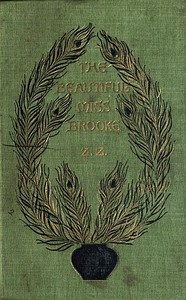
For The Beautiful Miss Brooke — Context and Discussion, the stored edition analysis reports 26,713 words, 1 hr 57 min estimated reading time, and 3 detected text sections.
The text analysis averages about 17.5 words per sentence, while the detected sections provide another way to judge how the source is divided.
Project Gutenberg metadata also associates the work with “English fiction,” connecting these edition facts with the source record’s subject description.
Explore this collection
These alternatives are selected using recorded categories and estimated reading time.
About 133 minutes
Machines Inventions Early Science Fiction
30,362 recorded words. 16 minutes difference from this book's estimate.
View Gutenberg source #33623About 69 minutes
Machines Inventions Early Science Fiction
15,856 recorded words. 48 minutes difference from this book's estimate.
View Gutenberg source #32795About 63 minutes
Machines Inventions Early Science Fiction
14,441 recorded words. 54 minutes difference from this book's estimate.
View Gutenberg source #32514Search stored excerpts and compare books → Choose by your preferences →
Choices use stored catalog measurements. Estimates vary with reading speed. A shared category is a catalog label, not a claim that two books have the same argument or literary quality.
Search reads excerpt text stored with this catalog and links to its associated Gutenberg record. The connection is stored in the site database; this tool does not recheck that every excerpt is word-for-word identical to that external record. Excerpt search does not cover every chapter and does not verify historical publication dates.
Catalog snapshot checked: 2026-09-25. Coverage: 94 public books, 94 available source excerpts.
Read the complete public-domain text at its original source.
Read on Project GutenbergLouis Zangwill opens The Beautiful Miss Brooke with Paul Middleton chafing at a party, his mind on a chess match rather than the dance. The narrator’s free indirect style lets us feel his irritation: “the girl to whom he had been talking was carried off to dance, for she had bored him intolerably.” This early focus on Paul’s interior state—his resentment of social obligation, his longing for intellectual contest—sets a pattern. The novel’s voice stays close to his perceptions, filtering Miss Brooke through his admiring but uncertain gaze.
Dialogue and description work in tandem. When Paul visits Miss Brooke’s Paris pension, the room’s details—a Japanese umbrella, a broken spring on the ottoman—are noted with the same precision as their conversations about platonic friendship. Zangwill lets objects and gestures carry subtext: the “hump” in the ottoman becomes a quiet emblem of their uneven relationship.
Zangwill’s word choices often signal what characters will not say outright. Paul “felt vaguely saint-like” when recounting his charities to Miss Brooke, the adverb vaguely undercutting the self-image he tries to project. Later, he notes that her “impartial and freezingly impersonal statements” about love leave him unable to read her. The adjective freezingly does more than describe tone—it suggests the emotional distance she maintains. Such diction turns ordinary exchanges into sites of tension.
Even physical actions carry lexical weight. Miss Brooke “made sensuous strokes on the canvas” while discussing ethics, the verb sensuous hinting at a vitality her words deny. Paul, meanwhile, “firmly restricted the number of his visits,” the adverb firmly revealing his effort at self-control. These small choices accumulate, making the reader attend to what is held back.
Conversations in the novel rarely advance plot; they advance concealment. Paul and Miss Brooke “drifted into the realm of ideas,” discussing love and platonic friendship in “great detail,” yet neither pierces the other’s facade. Zangwill renders their dialogue as a series of polite deflections. Miss Brooke’s interjections—“Yes, but don’t you really think that one ought to listen to such an appeal if . . .”—trail off, the ellipsis marking a boundary she will not cross.
Paul, for his part, edits his own biography: “Celia, for one thing, did not appear in it, and there were one or two little matters he was especially careful to suppress.” The novel’s dialogue thus becomes a performance, each speaker selecting what to reveal. Zangwill lets the gaps speak louder than the words, trusting readers to hear the silence between lines.
The Paris setting is rendered through precise, almost tactile details. Miss Brooke’s “little oblong sitting-room on the second floor” opens onto a balcony; Paul’s usual spot is “an old cretonne-covered ottoman, on which a broken spring made a curious hump.” These details are not decorative—they anchor the characters’ constrained intimacy. The hump becomes a recurring physical reminder of imperfection, much like the relationship itself.
Zangwill also uses setting to mark time and mood. Sunday excursions “beyond the fortifications to some rural spot” contrast with the indoor formality of the pension. Miss Brooke sketches “lazily” while they talk, the adverb softening the scene. Yet even these pastoral moments are framed by unspoken rules: Paul “did not abuse his privilege” of visiting. The novel’s geography—from garlanded alcoves to riverbank strolls—maps the boundaries of what can be said and done.
The narrative structure keeps the reader aligned with Paul’s limited knowledge. We learn of Miss Brooke only through his observations and her filtered confidences. Zangwill withholds her interiority, making her a puzzle Paul tries to solve. This asymmetry creates a quiet suspense: we watch him reconstruct “a fairly continuous account of her existence” without realizing it too “might also be selected.”
The novel’s pacing mirrors Paul’s own hesitation. Months pass in a paragraph; a single conversation stretches over pages. Zangwill uses this rhythm to emphasize the slow burn of attraction and doubt. The chess match Paul missed in Chapter I becomes a metaphor for the novel’s own strategic delays—every move is considered, every piece placed with care. Readers must attend to the board, not just the pieces.
Zangwill’s novel rewards attention to its verbal and structural choices. The diction, dialogue, and setting all work to create a world where what is unsaid matters as much as what is spoken. Readers will find that the story’s power lies not in dramatic events but in the careful calibration of tone and gesture. Approach the text as you might a chess game: watch for the small moves that shift the balance.
There’s something about Zangwill’s Miss Brooke—how every pause in her conversation feels like a held breath—that reminds me of the quieter anxieties in Three Thousand Dollars — Background and Themes. Both books trust what’s left unsaid. I still think about that Paris drawing-room, the way restraint can say more than any declaration ever could.
Build a private reading journal entry for this title.