About 372 minutes
The Sentimental Adventures of Jimmy Bulstrode — Edition Insights
Machines Inventions Early Science Fiction
85,442 recorded words. 112 minutes difference from this book's estimate.
View Gutenberg source #34065
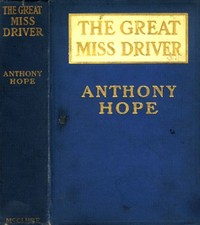
Before opening The Great Miss Driver — Inside the Classic, the edition data offers a quick orientation: 111,305 words, 8 hr 4 min estimated reading time, and 10 detected text sections.
The text analysis averages about 13.8 words per sentence, while the detected sections provide another way to judge how the source is divided.
Project Gutenberg metadata also associates the work with “Inheritance and succession -- Fiction,” connecting these edition facts with the source record’s subject description.
Explore this collection
These alternatives are selected using recorded categories and estimated reading time.
About 372 minutes
Machines Inventions Early Science Fiction
85,442 recorded words. 112 minutes difference from this book's estimate.
View Gutenberg source #34065About 350 minutes
Machines Inventions Early Science Fiction
80,344 recorded words. 134 minutes difference from this book's estimate.
View Gutenberg source #31659About 619 minutes
Machines Inventions Early Science Fiction
142,326 recorded words. 135 minutes difference from this book's estimate.
View Gutenberg source #32517Search stored excerpts and compare books → Choose by your preferences →
Choices use stored catalog measurements. Estimates vary with reading speed. A shared category is a catalog label, not a claim that two books have the same argument or literary quality.
Search reads excerpt text stored with this catalog and links to its associated Gutenberg record. The connection is stored in the site database; this tool does not recheck that every excerpt is word-for-word identical to that external record. Excerpt search does not cover every chapter and does not verify historical publication dates.
Catalog snapshot checked: 2026-09-25. Coverage: 94 public books, 94 available source excerpts.
Read the complete public-domain text at its original source.
Read on Project GutenbergThe novel opens not with Jenny Driver herself but with a conversation between her lawyer, Mr. Cartmell, and her private secretary, Austin. Cartmell recalls old Nick Driver's secretive nature: 'It wasn't your business—was it?—so he didn't talk to you about it.' This establishes a pattern of withheld information that persists throughout the excerpts. The narrator Austin is both insider and outsider, present at key confrontations yet often passive, as when Jenny dismisses him with 'Don't come with me.' The story's tension arises from what characters choose to reveal or conceal.
The catalog subject 'Inheritance and succession' is central but handled obliquely. Jenny Driver inherits a fortune from her father, old Nick Driver, but the excerpts focus less on the legal transfer and more on the social and emotional aftermath. Cartmell's reminiscence of Nick Driver's early dealings with the law firm suggests a history of strategic secrecy. Jenny's wealth enables her independence—she walks alone to confront Lord Fillingford—but also makes her a target. The blackmailer Powers is described as motivated 'only a matter of money,' and Jenny herself acknowledges that justice 'must be hard to give—from you to me.' The inheritance is a given, not a plot point; the narrative explores how Jenny wields its power.
Though cataloged under 'Private secretaries,' Austin is less a functionary than a witness. He narrates in first person, recording conversations he is permitted to overhear. When Jenny and Lord Fillingford speak, Austin notes, 'Neither took any heed of me, but I stayed—since she had not bidden me go.' His role is to observe and later manage fallout, as when he collects 'the fragments of Jenny's letter' and burns them. He is trusted but not fully confided in; Jenny's final 'God bless you, Austin' is affectionate but dismissive. The secretary's perspective filters the action, offering intimacy without full knowledge.
The catalog subject 'Elopement' appears only as a possibility. Jenny's letter to Lord Fillingford, torn and burned, may contain an elopement proposal or refusal—the text is never revealed. Fillingford's taunt 'You're not like Eleanor Lacey for nothing' hints at a prior elopement or scandal, but the excerpts provide no details. Jenny's calm demeanor—'both were speaking calmly and quietly'—suggests she is in control, not swept away by romance. The elopement theme remains latent, a weapon or rumor rather than an action. Readers must infer its significance from the characters' guarded references.
The excerpts present a novel of manners and manipulation, where legal and personal boundaries blur. Austin's narration offers a limited but privileged view; readers should attend to what is left unsaid—the torn letter, the unspoken past with Eleanor Lacey, the 'secret treaty' of chapter VIII. The catalog subjects provide entry points but not summaries. Approach the text as a puzzle of character and silence, where Jenny Driver's greatness may lie in what she chooses not to explain.
There’s something about Jenny Driver’s quiet stubbornness that lingers, the way a secretary’s loyalty bends around a secret. I found myself thinking of that same unhurried patience in Thirty — Story, Setting & Ideas, where the details feel less like plot and more like weather you live inside for a while. Funny how old books hold that. The Great Miss Driver does, too.
Answer a few questions and save a private reflection on this device.